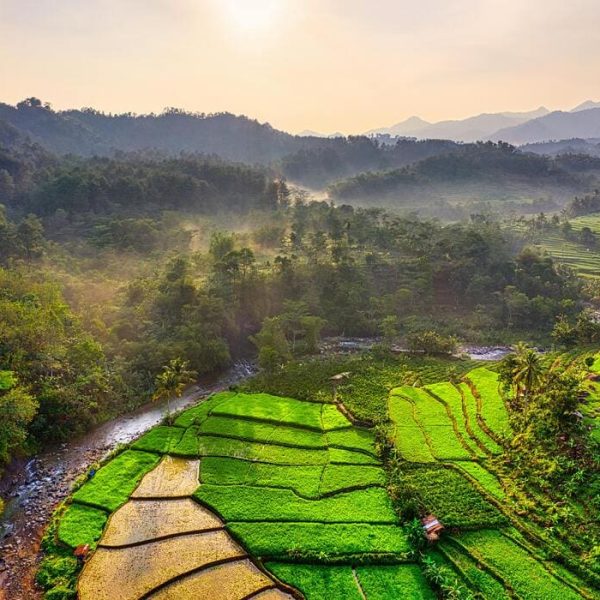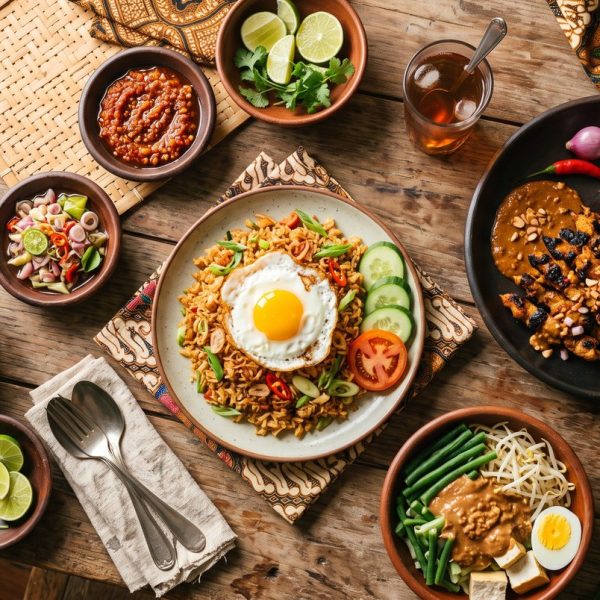
Indonesia spreads across more than 17,000 islands, and you can taste every one of those borders on a plate. Indonesian food is not a single cuisine so much as a conversation between hundreds of them, shaped by Chinese traders, Indian spice routes, Dutch colonists and Arab merchants, then bent into something entirely local. For a traveller, the fastest way to understand the country is often to sit down and eat.
What makes Indonesian food distinct
A few things anchor almost every meal. Rice sits at the quiet centre of the table, so central that in much of the country a meal without it barely counts as eating. Then there is sambal, the chilli paste that arrives in a hundred regional versions and turns up beside nearly everything. Add lemongrass, galangal, turmeric, shrimp paste and coconut, and you have the backbone of the flavours. Indonesian cuisine tends to layer sweet, salty, sour and spicy in the same mouthful, which is why a first bite can feel like several dishes at once.
The dishes worth knowing first
A handful of dishes will carry you a long way. Nasi goreng, the fragrant fried rice often crowned with a fried egg, is the unofficial national dish and a reliable first order. Satay, skewers of grilled meat with peanut sauce, is everywhere and hard to get wrong. Rendang, a slow-cooked beef curry from Sumatra, is so rich and complex it regularly lands on lists of the world's best foods. Gado-gado offers a vegetable and peanut answer for lighter appetites, and mie goreng does for noodles what nasi goreng does for rice. Work through those and you will have tasted a fair cross-section of popular Indonesian food.
Indonesian street food and the warung
Some of the best eating happens on the pavement. Indonesian street food is a world of its own, sold from carts called kaki lima and tiny family-run eateries known as warungs. Here you find martabak, a stuffed pancake that swings between savoury and sweet, bakso meatball soup ladled from steaming pots, and pisang goreng, fried banana eaten warm. The stalls are also where prices stay low and flavours stay honest. If you want to understand how a place actually eats, the roadside stall usually tells you more than the restaurant, a pattern you will find in cultures far beyond Indonesia, as this look at global street food makes clear.
The same country, many kitchens
Because the islands are so spread out, the food shifts sharply as you travel. Padang cuisine from West Sumatra is famous for its fiery, coconut-heavy curries served as a spread of small dishes, where you pay only for what you eat. Javanese cooking leans sweeter, often with palm sugar. Balinese food carries its own ceremonial dishes, including the slow-roasted suckling pig known as babi guling that you will not find in the Muslim-majority regions. Move on to Sulawesi or Papua and the staples change again, from grilled fish to sago. One label, Indonesian food, hides an enormous amount of variety.
Beyond the savoury
It would be a mistake to stop at the main dishes. Indonesia is one of the world's great coffee producers, and a cup of thick, sweet kopi tubruk is part of daily life. The desserts lean on coconut milk, palm sugar and pandan, giving cakes and puddings a green tint and a gentle, floral sweetness. Es cendol, a cold bowl of coconut milk, jelly and syrup, is the kind of thing you order once out of curiosity and then again out of pure habit.
Island food cultures reward travellers who move slowly and let the route follow the cooking rather than the other way round. The same principle applies on a long American drive, where the temptation is to chase famous names instead of building a us road trip map around the small towns that actually feed you well. Plan the driving days honestly and the meals stop being service-station compromises.
Regional cuisine is one of the more reliable ways to understand a place, since it reflects what was available rather than what was marketed. Cities develop the same kind of signature in their sporting culture. In Ohio that identity is bound up with the cleveland guardians to a degree outsiders find surprising.
How to eat like a local
A little curiosity goes a long way. Eat where the crowds are, since a busy warung is a good sign, and do not be shy about pointing at what someone nearby is enjoying. Learning even a few words of the local language helps more than you would expect, both for ordering and for the warmth it earns you, because people everywhere respond to being met in their own language. Ask about the sambal before you drown your plate in it, since heat levels vary wildly. And always leave room for the sweets and the coffee, both of which Indonesia does exceptionally well.
A few things to expect
Meals in Indonesia are often served all at once rather than in courses, and much of the food is eaten at room temperature, which surprises first-time visitors but keeps the flavours settled. In many homes and warungs you eat with your right hand or with a spoon and fork, the fork used to push food onto the spoon rather than to spear it. None of this is a test. Locals are quick to forgive a fumbling newcomer who is clearly enjoying the meal.
For a deeper dive into the dishes and their history, the overview of Indonesian cuisine is a useful map, and travellers swapping tips in the r/indonesia community are generous with recommendations for specific towns. However you approach it, the surest way to discover Indonesia is one plate at a time, letting the food introduce you to a country far too large and too varied to take in all at once.